

How To Clean Up Folds In Gimp
3.13. Heal
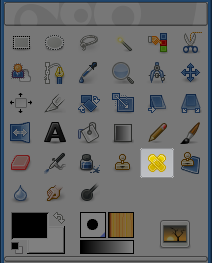
Figure xiv.96. The "Heal tool" in the Toolbox
This tool was once described equally "The healing brush looks like a smart clone tool on steroids". And indeed the Healing Tool is a close relative to the Clone Tool, only it is more smart to remove small-scale failures in images. A typical usage is the removal of wrinkles in photographs. To practice so, pixels are not merely copied from source to destination, but the surface area around the destination is taken into account earlier cloning is applied. The algorithm used for this, is described in a scientific paper by Todor Georgiev [GEORGIEV01].
To apply information technology, get-go choose a brush with a size adjusted to the defect. Then Ctrl -click on the area yous want to reproduce. Release the Ctrl key and elevate the sample to the defect. Click. If the defect is slight, not very different from its surrounding, information technology will be corrected as shortly. Else, you tin can correct it with repeated clicks, just with a chance of daubing.
3.xiii.1. Activating the Tool
There are different possibilities to activate the tool:
-
From the image-menu: → → ,
-
or past clicking the tool icon:
 in the Toolbox,
 -
or by clicking on the H keyboard shortcut.
3.xiii.2. Primal modifiers (Defaults)
- Ctrl
-
The Ctrl key is used to select the source. Yous can heal from any layer of any image, by clicking on the epitome display, with the Ctrl key held down, while the layer is active (as shown in the Layers dialog). If Alignment is gear up to "Non-aligned" or "Aligned" in Tool Options, then the point you click on becomes the origin for healing: the epitome data at that point will be used when you offset brainstorm painting with the Heal tool. In source-choice style, the cursor changes to a crosshair-symbol.
- Shift
-
Once the source is set, if you printing this key, you lot will see a sparse line connecting the previously clicked betoken with the current pointer location. If y'all click over again, while going on holding the Shift key down, the tool will "heal" along this line.
3.13.3. Options
Effigy fourteen.97. Heal Tool options
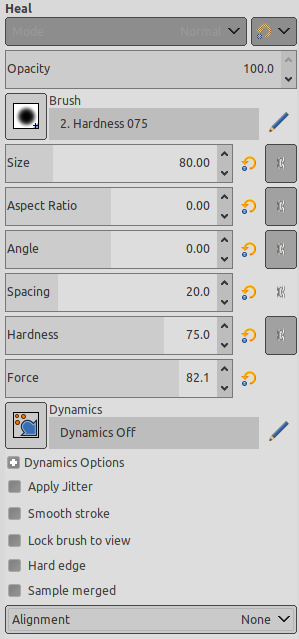
Commonly, tool options are displayed in a window attached under the Toolbox as soon as you lot actuate a tool. If they are non, yous tin can admission them from the epitome carte du jour bar through → → which opens the option window of the selected tool.
- Mode; Opacity; Castor; Size; Attribute Ratio; Bending; Spacing; Hardness; Dynamics; Dynamics Options; Strength; Apply Jitter; Smoothen Stroke; Lock castor to view
-
Encounter the Common Paint Tool Options for a description of tool options that employ to many or all paint tools.
Hard edge: this option gives a hard contour to the healed area.
- Sample merged
-
If you enable this option, healing is not calculated only from the values of the active layer, but from all visible layers.
Encounter Section 3.12, "Clone" for using Sample Merged in non-destructive prototype editing.
- Alignment
-
This selection is described in Clone tool.
3.thirteen.four. Healing is not cloning
Although the Heal tool has common features with the Clone tool on using, the result is quite different.
Effigy 14.98. Comparing "Clone" and "Heal"

Source: https://docs.gimp.org/2.10/en/gimp-tool-heal.html
Posted by: gentrynitandeaughs.blogspot.com
0 Response to "How To Clean Up Folds In Gimp"
Post a Comment